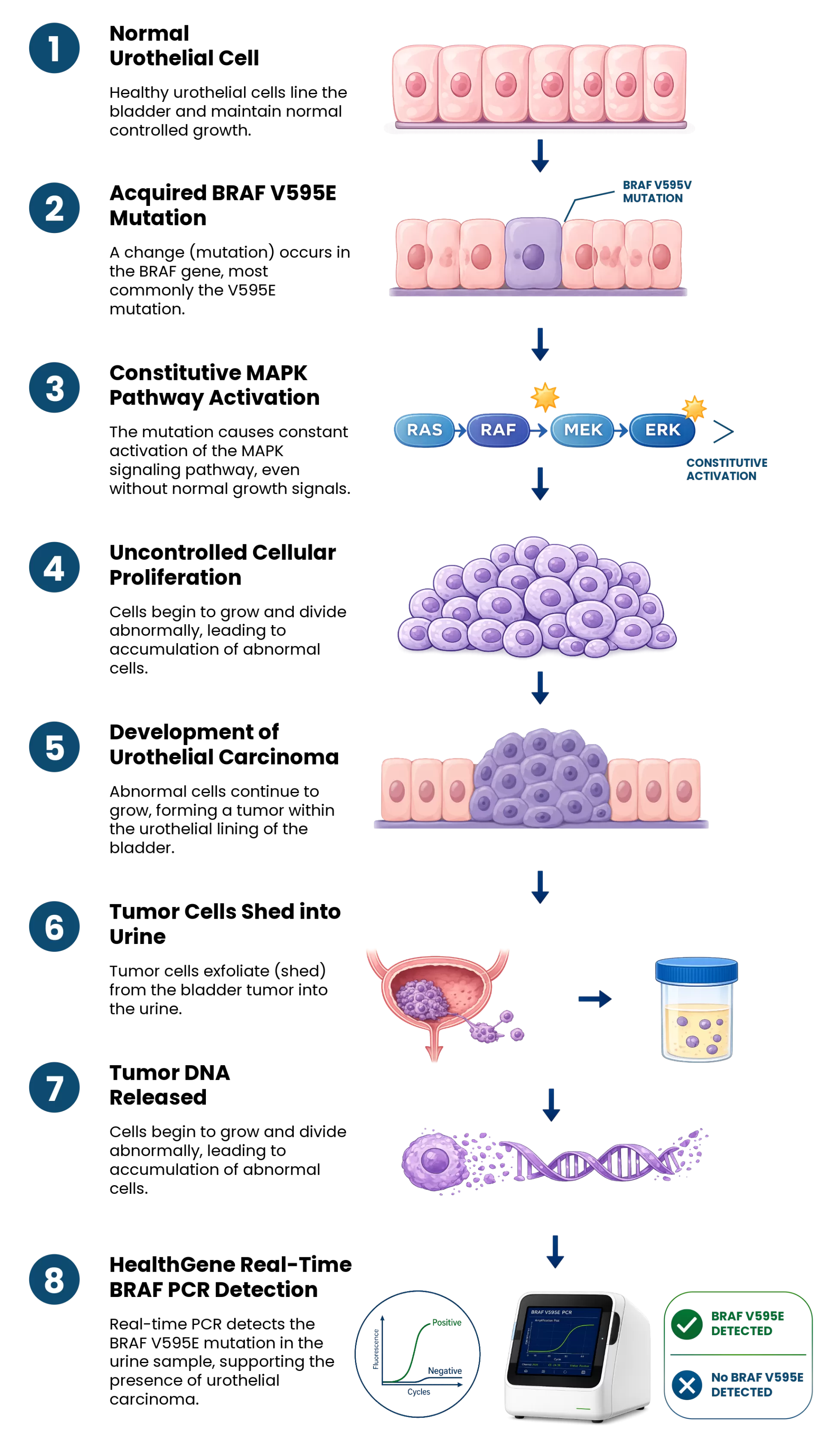
The BRAF gene encodes a serine/threonine protein kinase that is part of the RAS–RAF–MEK–ERK (MAPK) signaling pathway, a highly regulated cellular communication network responsible for controlling normal cell growth, differentiation, proliferation, and survival.
Under normal physiological conditions, this pathway is activated only in response to external growth signals. Once those signals are removed, pathway activity returns to baseline, ensuring controlled cell division and normal tissue homeostasis.
In many dogs with urothelial carcinoma (UC) and a subset of prostatic carcinomas, a specific mutation known as BRAF V595E results in continuous activation of the MAPK pathway. This mutation causes the BRAF protein to remain constitutively active, allowing cells to proliferate independently of normal regulatory mechanisms. Over time, this uncontrolled cellular growth contributes to the development and progression of malignant tumors.
Because urothelial tumors are in direct contact with urine, neoplastic cells are continuously exfoliated into the urinary tract. As these cells undergo normal turnover, they release DNA containing the BRAF V595E mutation into the urine. This tumor-derived DNA can be isolated and analyzed using molecular diagnostic techniques.
The HealthGene BRAF PCR Test detects this mutation directly from urinary DNA, providing a non-invasive method for identifying mutation-positive urothelial and prostatic carcinomas without the need for tissue biopsy in many clinical situations.
The HealthGene BRAF PCR Test uses real-time Polymerase Chain Reaction (PCR) to amplify and detect the presence of the BRAF V595E mutation in DNA extracted from urine samples.
The testing process involves several key steps:
Because PCR amplifies specific DNA sequences, only a small amount of tumor-derived DNA is required for analysis, allowing highly sensitive detection even when relatively few neoplastic cells are present in the sample.
Traditional diagnostic methods evaluate the structural or microscopic appearance of tissues, whereas molecular diagnostics evaluate the genetic alterations that drive tumor development.
The BRAF PCR Test provides information that cannot be obtained through routine urinalysis alone by detecting a well-characterized oncogenic mutation associated with canine urothelial carcinoma.
When interpreted alongside clinical findings, imaging studies, cytology, and histopathology, molecular testing contributes an additional layer of diagnostic information that may improve clinical confidence and support earlier diagnostic investigation.
Detection of the BRAF V595E mutation provides strong molecular evidence supporting the presence of a mutation-positive urothelial or prostatic carcinoma. However, molecular findings should always be interpreted within the context of the patient's overall clinical picture.
A positive result should prompt appropriate diagnostic evaluation, which may include:
Similarly, a negative BRAF result does not exclude malignancy. While the BRAF V595E mutation is common in canine urothelial carcinoma, not all tumors harbor this genetic alteration. In dogs with persistent clinical suspicion despite a negative result, additional diagnostic procedures remain warranted.