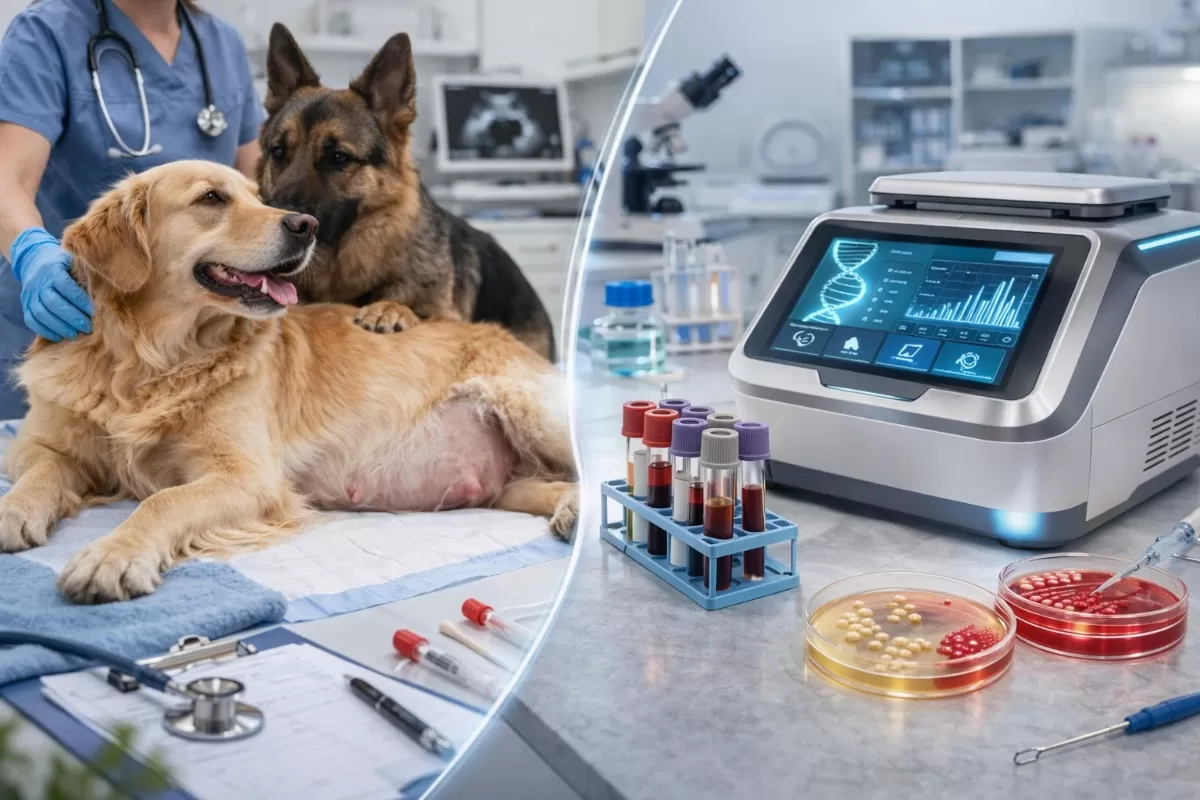
Reproductive failure in dogs can be frustrating, costly, and diagnostically complex. Infertility, early embryonic loss, abortion, stillbirths, neonatal mortality, orchitis, epididymitis, and subfertility may all have infectious etiologies — yet identifying the underlying cause requires a structured and evidence-based approach.
Because no single test provides complete diagnostic certainty, combining PCR-based molecular diagnostics with aerobic bacterial culture and antimicrobial susceptibility testing offers the most comprehensive strategy.
This article outlines a practical diagnostic framework for evaluating infectious causes of canine reproductive failure in both females and males.
Reduce conception rates
Cause embryonic resorption
Trigger late-term abortion
Lead to neonatal mortality
Result in subclinical infertility
Spread within breeding programs
Early and targeted diagnostic testing helps prevent repeated failed breeding and supports kennel biosecurity.
Brucella canis remains one of the most significant infectious causes of reproductive loss in dogs¹²³.
In females:
• Late-term abortion (typically 45–55 days gestation)
• Embryonic resorption
• Persistent vaginal discharge
• Infertility
In males:
• Epididymitis
• Orchitis
• Testicular atrophy
• Reduced semen quality
Dogs may appear clinically normal between reproductive events¹³.
• Bacteremia can be intermittent
• Shedding varies over time
• Culture sensitivity may be limited
• Zoonotic risk requires strict handling precautions²
PCR enhances detection, particularly when combined with serologic screening³.
CHV-1 contributes to:
• Early embryonic death
• Abortion
• Neonatal mortality (“fading puppy syndrome”)⁶
The virus establishes latency and may reactivate during stress or pregnancy⁶.
PCR is preferred for detecting active shedding in vaginal swabs, semen, placental tissue, or aborted fetuses⁶.
• These organisms may be:
• Normal mucosal colonizers
• Opportunistic pathogens
• Associated with infertility, vaginitis, prostatitis, or reduced semen quality⁵
Because they are fastidious and difficult to culture, PCR improves detection sensitivity⁵. Interpretation must always be correlated with clinical findings.
In breeding females, opportunistic bacterial pathogens may cause:
• Vaginitis
• Endometritis
• Ascending uterine infections
• Pyometra
• Early embryonic loss
• Neonatal septicemia
Although these organisms can be part of normal flora, significant growth combined with inflammation supports pathogenic involvement².
Culture confirms viable organisms and allows antimicrobial susceptibility testing — critical for targeted therapy and antimicrobial stewardship².
Although leptospirosis is primarily associated with renal and hepatic disease, Leptospira spp. can localize in the reproductive tract and contribute to reproductive dysfunction⁷⁸.
Reported reproductive manifestations include:
• Orchitis
• Epididymitis
• Reduced semen quality
• Infertility
• Venereal transmission in some cases⁷
Leptospiral DNA has been detected in semen and reproductive tissues, and infected males may serve as asymptomatic carriers⁷⁸.
• Shedding may be intermittent
• Serology indicates exposure but not necessarily active shedding
• PCR allows direct detection of organism DNA in reproductive samples⁷
Screening breeding males for Leptospira supports kennel biosecurity and reduces transmission risk.
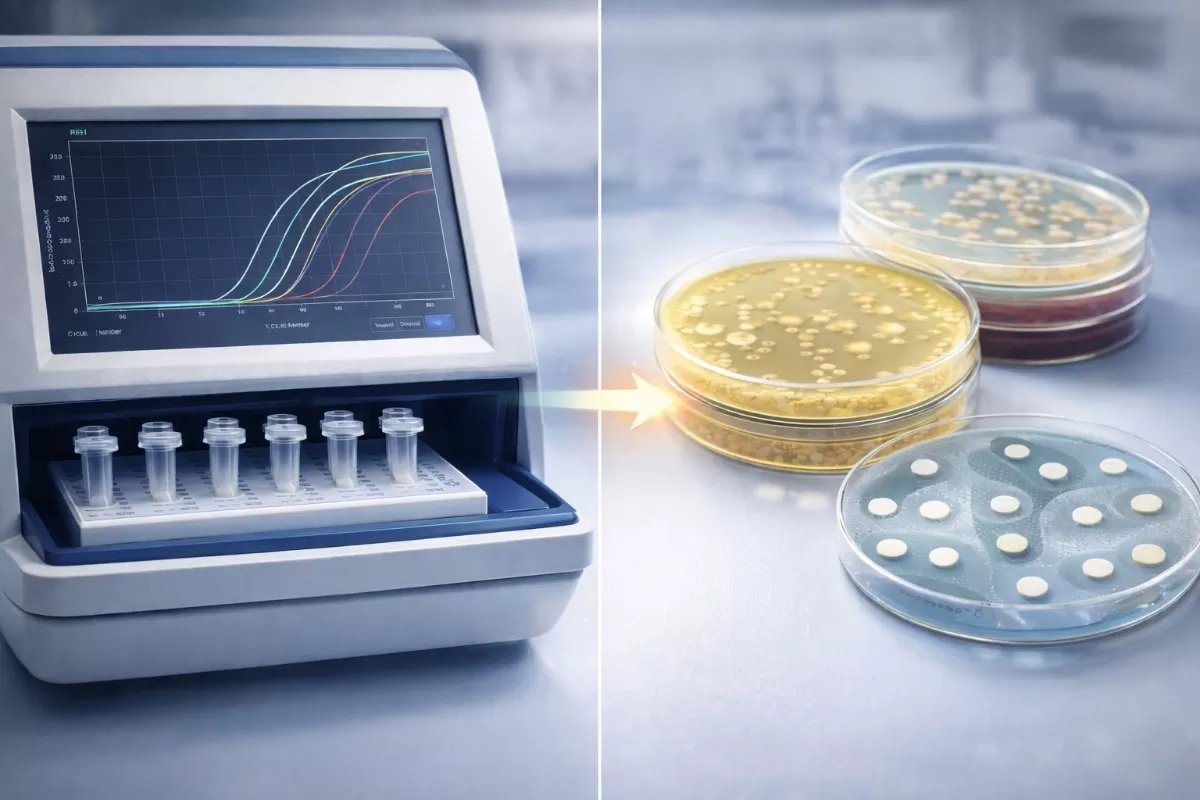
PCR and culture are complementary tools.
✔ Infertility is unexplained
✔ Multiple breedings have failed
✔ Abortion or neonatal mortality has occurred
✔ Epididymitis or orchitis is present
✔ Empirical antibiotic therapy has failed
✔ Biosecurity concerns exist¹²³
PCR enhances detection of fastidious and intracellular organisms,
while culture confirms viable bacteria and enables antimicrobial
susceptibility testing².
Brucella canis PCR¹³
CHV-1 PCR⁶
Mycoplasma spp. PCR⁵
Ureaplasma spp. PCR
Aerobic bacterial culture (including Staphylococcus aureus and Streptococcus spp.)²
Antimicrobial susceptibility testing
Placental or fetal tissues for PCR and culture⁶
Brucella canis PCR¹³
CHV-1 PCR⁶
Mycoplasma spp. PCR⁵
Ureaplasma spp. PCR
Leptospira spp. PCR⁷
Aerobic culture + antimicrobial susceptibility testing
(Note: Staphylococcus and Streptococcus testing is specific to the female panel.)
Canine reproductive failure requires a structured and evidence-based diagnostic strategy.
Infectious causes — particularly Brucella canis, CHV-1, Mycoplasma spp., Ureaplasma spp.,
opportunistic bacterial pathogens in females, and Leptospira spp. in males — should be
evaluated early in the diagnostic process¹²³⁵⁶⁷.
A combined approach using:
provides the most clinically actionable information and supports responsible antimicrobial stewardship².
Early diagnostic testing is preferable to repeated unsuccessful breeding or empirical therapy.

¹ Cornell University — Canine Brucellosis Overview — Cornell Richard P. Riney Canine Health Center (online summary).
² Brucellosis in Dogs — MSD Veterinary Manual.
³ Canine brucellosis: An update — Frontiers in Veterinary Science (2021).
https://www.frontiersin.org/journals/veterinary-science/articles/10.3389/fvets.2021.594291/full
⁴ Canine Brucellosis — Clinical Microbiology Reviews (Hollett 2006) — PubMed abstract.
⁵ Association of Mycoplasma canis with Fertility Disorders in Dogs
https://www.mdpi.com/2076-0817/13/5/391?utm_source=chatgpt.com
⁶ Canine Herpesvirus-1 Infection — MSD Veterinary Manual – Professional Edition
⁷ Leptospirosis as a Cause of Reproductive Failure
https://www.sciencedirect.com/science/article/abs/pii/S0749072015305326?utm_source=chatgpt.com
⁸ Leptospira and Leptospirosis (Springer) — Comprehensive reference
https://link.springer.com/book/10.1007/978-3-662-45059-8?utm_source=chatgpt.com
